
OP-ED: Kalinago Self-Determination and Sovereignty
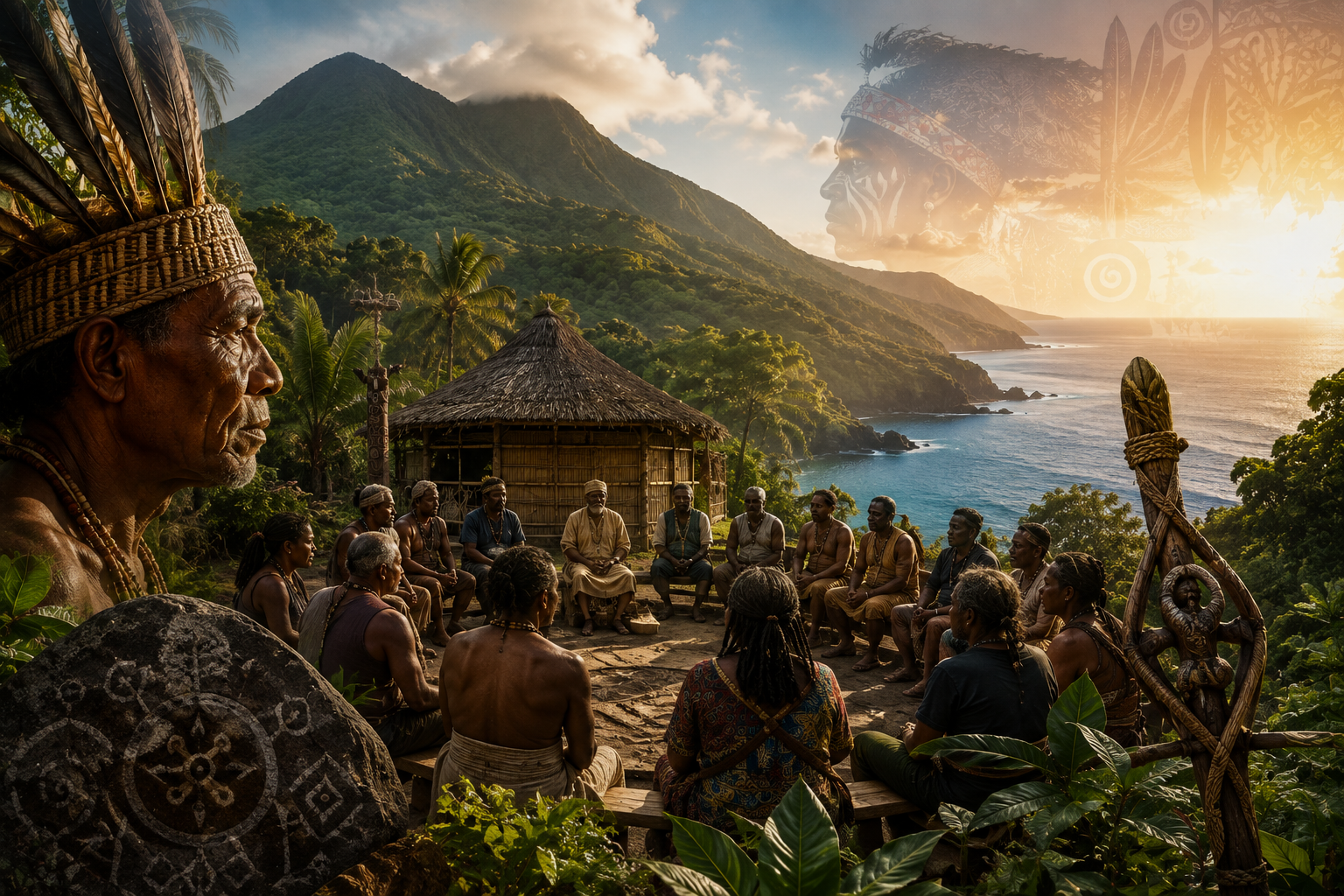
AI Generated Photo
Should Dominica’s Indigenous Peoples Have Their Own Government?
Written By Rhianna Serrant
There is a question that sits quietly at the heart of Dominica's history.
It is a question about land.
It is a question about identity.
And ultimately, it is a question about who has the right to decide what happens in a place that Indigenous people have called home for generations.
For centuries, the Kalinago people have maintained a distinct cultural identity and connection to the land despite colonization, displacement, and the many political changes that followed. The Kalinago are recognized as the Indigenous people of Dominica, with a distinct history, culture, and communal relationship with the land. (Office of the United Nations High Commissioner for Human Rights, 2010).
Today, the Kalinago Territory remains an important part of Dominica's national identity.
But one question continues to deserve serious discussion:
Should Dominica's Indigenous people have their own government?
For some, the answer is an obvious yes.
For others, the idea raises difficult questions about national unity, constitutional authority, resources, and what self-government would actually mean within a small island state.
The debate, however, should not begin with fear.
It should begin with history.
The Kalinago are not simply another community within Dominica. They are the descendants of the Indigenous people who inhabited the island before European colonization.
Their relationship with Dominica's land predates the modern Dominican state.
Their traditions, cultural practices, knowledge, and connection to the environment form part of a history that cannot be separated from the story of the island itself.
Yet having a distinct history does not automatically answer the question of political authority.
The Kalinago Territory already has its own local representative institution, the Kalinago Council. Under the Carib Reserve Act, the Council has specific responsibilities relating to the management and control of lands within the Territory and matters concerning the welfare and development of the community (Government of Dominica, Ministry of Kalinago Affairs, n.d.; World Bank, 2019).
The Council provides a form of community governance and representation.
But its authority exists within the wider framework of the Government of Dominica.
And this is where the debate becomes more complicated.
What does self-determination actually mean?
Does it mean complete political independence?
Does it mean creating a separate state within Dominica?
Or does it mean giving the Kalinago people greater control over the decisions that directly affect their community?
Perhaps the answer does not have to be all or nothing.
The idea of greater autonomy deserves serious consideration.
Internationally, Indigenous self-determination is recognized as a fundamental right. The United Nations Declaration on the Rights of Indigenous Peoples states that Indigenous peoples have the right to self-determination and, in exercising that right, have the right to autonomy or self-government in matters relating to their internal and local affairs (United Nations, 2007).
Imagine a system in which the Kalinago people have stronger authority over matters such as land use, cultural preservation, environmental management, community development, education, and economic planning within the Territory.
Such a system would not necessarily mean creating another country.
It could mean strengthening Indigenous self-government while maintaining Dominica's national sovereignty.
For many Kalinago people, land is not simply property.
It represents history, identity, inheritance, and connection.
That makes decisions about development particularly important.
When roads are built, businesses established, natural resources used, or major projects proposed, the people who live on and identify with that land should have a meaningful voice in determining what happens.
Consultation should not simply mean informing people after decisions have already been made.
True self-determination requires meaningful participation in the decisions themselves. The United Nations Declaration on the Rights of Indigenous Peoples recognizes Indigenous peoples' right to participate in decision-making in matters that affect them and to maintain their own political, legal, economic, social, and cultural institutions (United Nations, 2007).
This is where the debate about government becomes important.
A stronger Kalinago government could potentially provide the community with greater control over its own priorities.
It could allow leaders chosen by the Kalinago people to develop policies based specifically on the needs of the Territory rather than relying primarily on decisions made elsewhere.
But there are also legitimate concerns.
Dominica is one sovereign nation.
Creating a completely separate government could raise difficult questions about taxation, policing, education, infrastructure, natural resources, and the relationship between Kalinago laws and national laws.
These concerns cannot simply be dismissed.
Self-government must be practical as well as principled.
But national unity should not require Indigenous communities to surrender meaningful control over their own affairs.
Dominica can remain one country while recognizing that different communities may require different forms of governance.
In fact, greater autonomy could strengthen national unity rather than weaken it.
When people feel that their history, culture, land, and political voice are respected, they are more likely to feel that they belong within the national project.
The goal should not be to isolate the Kalinago people from the rest of Dominica.
It should be to ensure that they have a stronger voice within it.
There is also an economic dimension to the conversation.
The Kalinago Territory possesses significant cultural and environmental value. Tourism, agriculture, traditional knowledge, craft, forestry, and other community-based industries can contribute to economic development.
But economic development should not happen to Indigenous communities.
It should happen with them.
And ideally, it should allow the people of the Territory to benefit directly from the resources, businesses, and opportunities created within their community.
This is where self-determination becomes more than a political slogan.
It becomes an economic question.
Who makes the decisions?
Who controls the resources?
Who receives the benefits?
And who carries the consequences when development goes wrong?
These are questions that every Dominican should be willing to discuss.
The debate over Indigenous government should also be approached with care because there is a difference between equality and equity.
Treating everyone exactly the same does not always produce fairness.
Sometimes fairness means recognizing historical circumstances and providing communities with the authority necessary to protect their identity and determine their own future.
The Kalinago people do not need to be separated from Dominica to have a stronger political voice.
They need meaningful power to shape the future of their own community.
Perhaps the better question is therefore not:
"Should the Kalinago have their own government?"
Perhaps we should ask:
"How much self-government should the Kalinago people have within the sovereign state of Dominica?"
That question opens the door to a more constructive conversation.
It allows us to consider stronger legislative authority for the Kalinago Council, greater control over land and development decisions, increased protection for cultural heritage, and meaningful participation in decisions affecting the Territory.
It also allows Dominica to explore a model of Indigenous governance that reflects our own history rather than simply copying systems from other countries.
Dominica has an opportunity here.
As a nation that proudly celebrates its natural environment, cultural diversity, and Indigenous heritage, we should be willing to examine whether our political structures adequately reflect the people whose history existed here long before the modern state.
The future of the Kalinago people should not be determined solely by outsiders.
Nor should the future of Dominica be built without them.
Self-determination does not have to mean separation.
Sovereignty does not have to mean exclusion.
And national unity does not have to mean uniformity.
The real challenge is finding a balance between the sovereignty of the Dominican state and the right of its Indigenous people to have meaningful control over their own affairs.
Because a nation's strength is not measured only by how united it appears.
It is also measured by how fairly it treats the people whose history helped build it.
The question of Kalinago self-government is therefore not simply a question about creating another government.
It is a question about recognition.
It is a question about representation.
It is a question about land, culture, identity, and power.
And ultimately, it is a question about whether Dominica is prepared to give its Indigenous people not only a place within its history, but a greater role in determining its future.
Because self-determination is not simply about who governs.
It is about who gets to decide what comes next.
References
Government of Dominica, Ministry of Kalinago Affairs. (n.d.). Indigenous peoples plan. https://www.kalinagoaffairs.gov.dm/news/indigenous-peoples-plan
Office of the United Nations High Commissioner for Human Rights. (2010). Report of the Special Rapporteur on the situation of human rights and fundamental freedoms of indigenous people: Mission to Dominica. https://documents.un.org/doc/undoc/gen/g10/100/98/pdf/g1010098.pdf
United Nations. (2007). United Nations Declaration on the Rights of Indigenous Peoples. https://www.un.org/development/desa/indigenouspeoples/declaration-on-the-rights-of-indigenous-peoples.html
World Bank. (2019). Indigenous peoples planning framework: Dominica. https://documents1.worldbank.org/curated/en/959021549639944890/pdf/INDIGENOUS-PEOPLES-PLANNING-FRAMEWORK.pdf