
Kubuli Farms: Cultivating Innovation, Inclusion and Opportunity in Dominica
For more than thirty years, Jeffrey Bruney has shown what is possible when agriculture is treated not just as work, but as purpose. A farmer from Thibaud, Dominica, and the founder of Kubuli Farms, Bruney’s journey reflects how farming can create livelihoods, strengthen food systems, and open doors for people who are often left on the margins of the sector.
Bruney has been a commercial farmer for 34 years, though his path into agriculture was not a straight line. After leaving high school, he spent a decade working at Cable and Wireless. While the job provided steady income, it did not provide fulfillment.
“It was a good job in terms of pay, but it was not what I wanted to do. I had no interest in telecommunications as a career,” he says.
Agriculture, on the other hand, felt meaningful. Encouraged by the late Prime Minister Roosevelt “Rosie” Douglas, Bruney was reminded that food production is work that matters deeply to society.
“He said to me, ‘If your passion can be your livelihood, there’s no better life than that. That is what made me really go into agriculture with purpose.”
For Bruney, farming offered dignity, independence, and the chance to contribute to something essential.
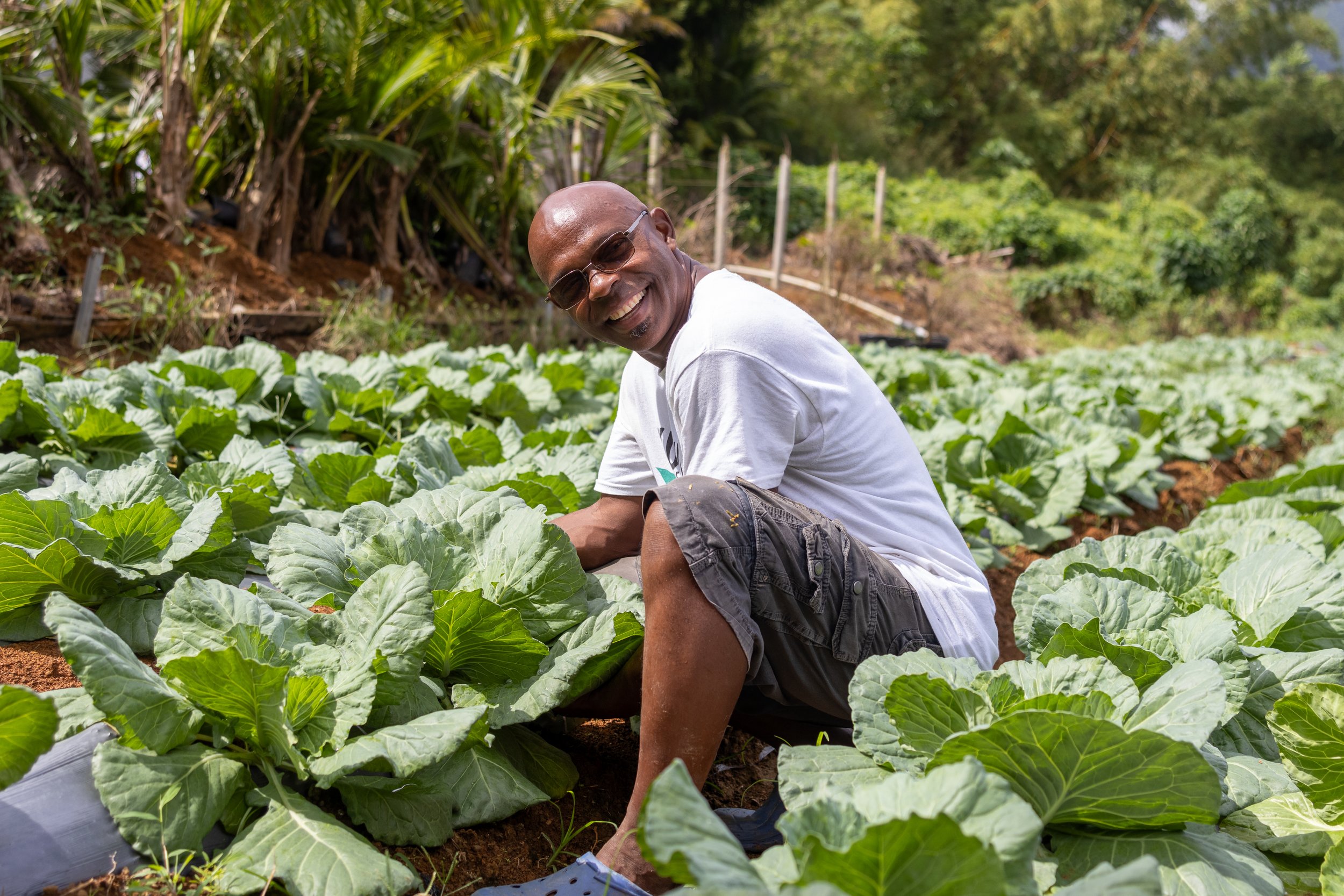
Jeffrey Bruney on his farm amongst cabbage plants
In 2000, he migrated with intention — not to leave agriculture behind, but to strengthen his skills. He pursued a business degree and later trained in hydroponics, aquaponics, aquaculture, and other modern farming systems at Cornell University. Living and working in New York and later Sweden gave him global exposure while reinforcing his commitment to returning home.
During his time abroad, Bruney worked on agricultural projects that supported food access, including greenhouse production for organizations such as the Salvation Army and United Way. These experiences showed him that farming could be innovative, efficient, and socially impactful all at once.
By 2019, he felt a strong pull to return to Dominica permanently. Kubuli Farms, which he had started during visits home in 2012, became the platform through which he would apply everything he had learned.
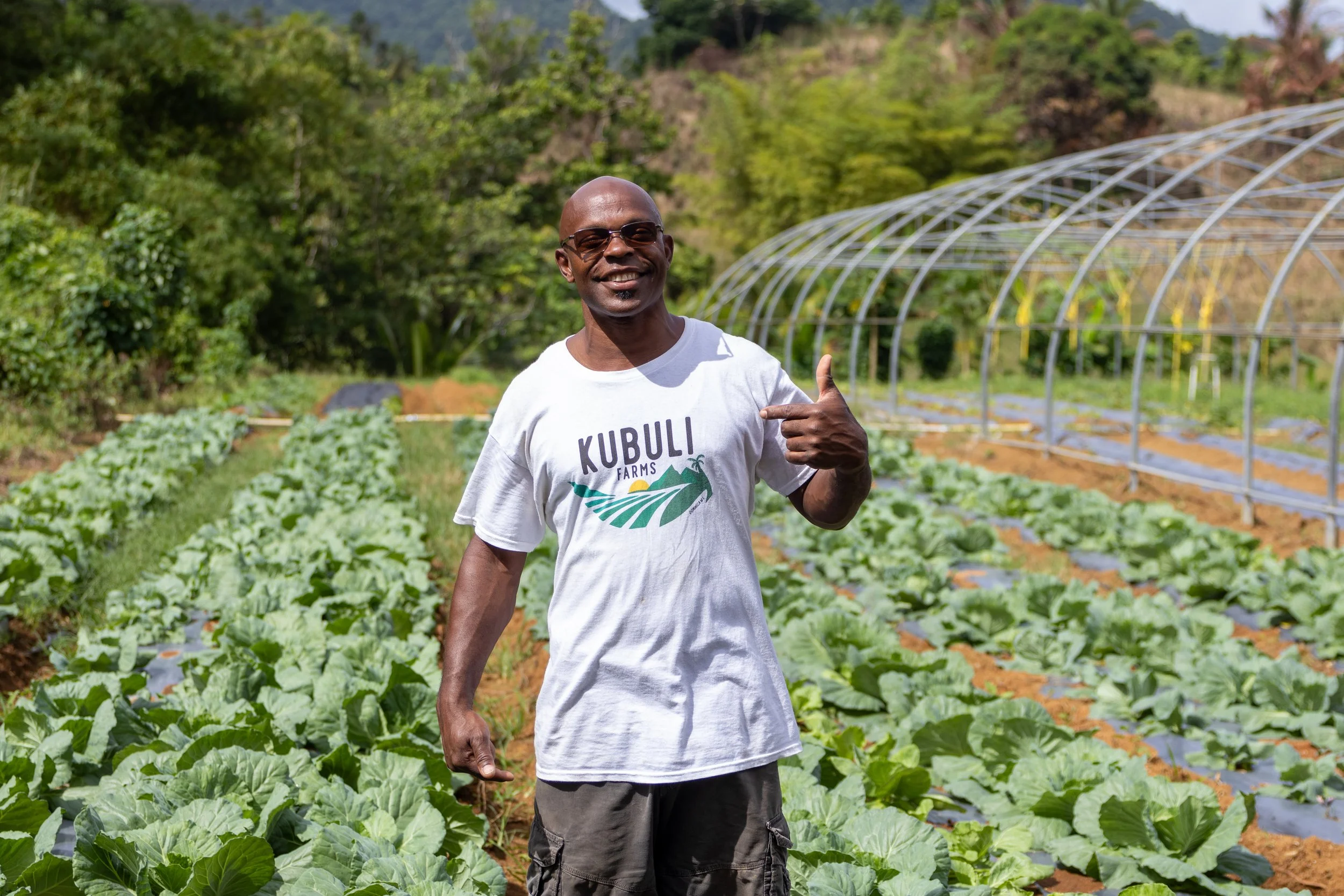
At Kubuli Farms, innovation is designed with local realities in mind. Bruney focuses on reducing costs, increasing efficiency, and making modern farming accessible. Rather than relying on expensive imported systems, the farm uses greenhouses built from locally available materials such as bamboo and PVC. Hybrid aquaponics systems turn fish waste into organic fertilizer delivered through drip irrigation, cutting down on chemical inputs and lowering operating costs.
These methods help protect the environment while ensuring farmers can remain productive and competitive.
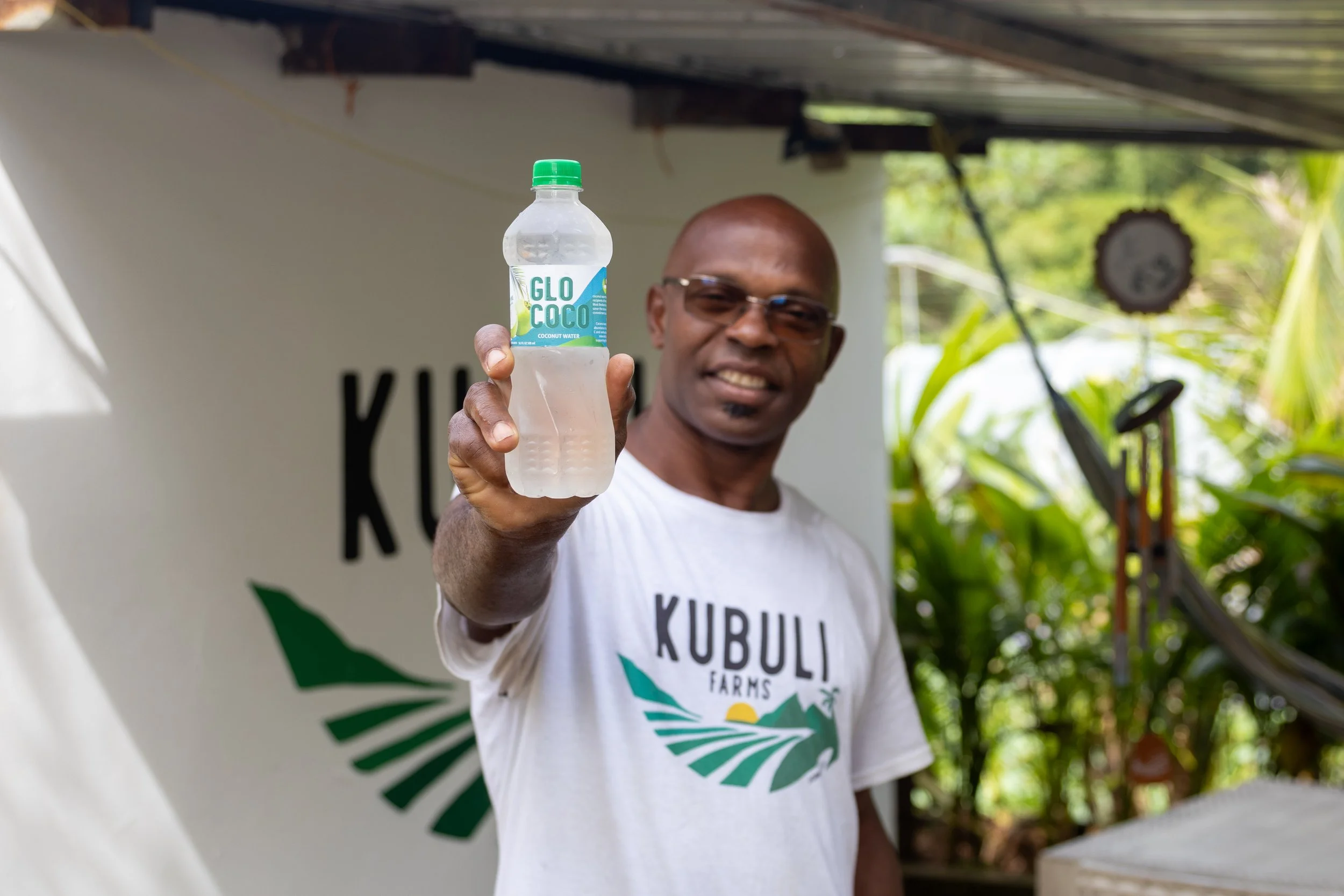
Kubuli Farms’ flagship product, Glo Coco coconut water, has become a familiar green-labeled brand in Dominican supermarkets. Coconut production forms the backbone of the farm’s operations, meeting growing local and international demand. Secondary crops such as tomatoes, lettuce, bell peppers, and cabbages help strengthen local food supply and dietary variety.
Just one year after expanding production, Bruney was recognized as Farmer of the Year for Innovation — a moment that affirmed the value of farming that is efficient, responsible, and forward-looking.
Beyond crops, Kubuli Farms also addresses one of agriculture’s biggest challenges: labour. Bruney is open about the difficulty of finding skilled workers for areas such as hydroponics, nurseries, and farm management. In response, he has built a diverse workforce that includes Dominican nationals, young people, workers from the Kalinago Territory, and migrant workers from Haiti and Cuba.
This inclusive approach allows the farm to fill labour gaps while offering safe, lawful employment and skills development. Recent legislation supporting the legal recruitment of foreign agricultural workers has further strengthened this model, ensuring that workers’ rights and dignity are respected while keeping farms productive.
Kubuli Farms also serves as a space for groups often disconnected from agriculture to re-engage:
Youth are introduced to farming as a business and a career that uses technology, leadership, and innovation, challenging the idea that agriculture is outdated or unprofitable.
Men see agriculture modeled as a modern profession that offers financial independence and entrepreneurial opportunity.
Migrants and members of the diaspora are encouraged to bring their skills home. Bruney’s own return shows how knowledge gained abroad can be reinvested locally to meet growing demand driven by tourism, infrastructure development, and expanding markets.
Through Kubuli Farms, Jeffrey Bruney demonstrates that agriculture is far more than planting and harvesting. It is a driver of food security, employment, innovation, and social inclusion. By treating farming as a business, embracing modern methods, and welcoming diverse participation, he contributes to a stronger and more resilient Dominica.
As the country looks ahead to growth and new opportunities, Bruney’s work offers a clear example of how the private sector can lead responsibly — building livelihoods today while safeguarding the future.
In cultivating crops, people, and possibilities, Jeffrey Bruney is not only farming the land. He is helping to shape a more resilient and inclusive future for Dominica.
